


Arizona copper draws national attention

Arizona's position as supplier of 2/3 of the nation's copper means that what happens in mining here gets national and international attention. [Right, copper wire. Credit, Freeport McMoRan]
The New York Times weighed in on the debate over the proposed Rosemont Copper mine south of Tucson, in an article that draws heavily from critics of mining, calling it a clash over mining and water.
Business Insider looks at Arizona copper in a broader sense but dives in on the proposed land exchange needed for the Resolution Copper underground mine near Superior to go forward.
Arizona moves into 3rd for solar energy installed
Arizona ranks third in the nation in terms of solar system installation, according to the 2011 U.S. Solar Market Insight Report from the Solar Energy Industries Association (SEIA).
Arizona’s energy production from photovoltaic systems jumped from 63 to 273 megawatts between 2010 and 2011 – a 333% rate of growth. Arizona now trails only California and New Jersey in terms of solar megawatt production, and the SEIA report projects Arizona will jump into 2nd place nationally this year.
Nationally, energy production from photovoltaic installations grew 109% in 2011, according to the SEIA report. Growth was found in every market segment (residential, non-residential and utility), and project finance investments reached an all-time high. In total, $8.4 billion worth of photovoltaic systems were installed in the United States last year alone.
A press release from Gov. Brewer's office this afternoon reports that Arizona ranked 3rd nationally in 2011 with nearly 4,800 jobs in the solar energy field, according to the National Solar Jobs Census, issued in October by The Solar Foundation. Since 2010, nine renewable-energy companies have located or expanded operations in Arizona – creating more than 2,100 jobs and investing more than $1 billion in capital.
[taken in part from the Governor's news release]
READ MORE - Arizona moves into 3rd for solar energy installed
Arizona’s energy production from photovoltaic systems jumped from 63 to 273 megawatts between 2010 and 2011 – a 333% rate of growth. Arizona now trails only California and New Jersey in terms of solar megawatt production, and the SEIA report projects Arizona will jump into 2nd place nationally this year.
Nationally, energy production from photovoltaic installations grew 109% in 2011, according to the SEIA report. Growth was found in every market segment (residential, non-residential and utility), and project finance investments reached an all-time high. In total, $8.4 billion worth of photovoltaic systems were installed in the United States last year alone.
A press release from Gov. Brewer's office this afternoon reports that Arizona ranked 3rd nationally in 2011 with nearly 4,800 jobs in the solar energy field, according to the National Solar Jobs Census, issued in October by The Solar Foundation. Since 2010, nine renewable-energy companies have located or expanded operations in Arizona – creating more than 2,100 jobs and investing more than $1 billion in capital.
[taken in part from the Governor's news release]
U.S. Solar Market Insight Report
View more documents from Solar Energy Industries Association
National Inspire Integrity Award to UA's George Davis

UA geosciences professor (and former Provost) George Davis [right, credit NCSS] has received the Inspire Integrity Award from the National Society of Collegiate Scholars. This is "the only national student-nominated faculty awards program. These awards are presented to full-time university faculty and administration who have, through their lessons and actions, made a significant impact on the lives of their students and instilled a high degree of personal and academic integrity."
The winner receives $1,000 plus $1,000 for the foundation of his/her choice.
Arizona State Mining Championship at stake in Boom Town Spree

The Miami (AZ) Boom Town Spree festivities begin Friday, April 20 and run through the weekend. The best manual miners in the state compete in such events as hand drilling and team drilling, which are judged by an official from the Mine Inspector's Office. There are also competitions for spike driving and mucking. At stake is the title of Arizona State Mining Champion, a cash prize, and a coveted Boom Town Spree embroidered Carhart coat.
The weekend also features cultural dancing, arts and crafts, live musical entertainment, activities for kids, bed races, a car show, a street dance, antique mining equipment displays, and more.
[Thanks to Jeanne Francis-Harris with the festival for passing along the details]
AZGS store carries hunting & fishing licences, tags, and stamps

The AZGS store in downtown Tucson is now an authorized AZ Game and Fish Dept. dealer. We carry all Hunting and Fishing licenses, tags, and stamps.
This is a step towards our new emphasis on becoming a one-stop destination for government publications and materials. Remember, we are the official outlet for all USGS topo maps of Arizona, as well as a large selection of US Forest Service and BLM maps.
ASU team produces geologic map of Jovian moon Io

A team of scientists led by Arizona State University (ASU) has produced the first complete global geologic map of the Jovian satellite, Io. The map, published by the U. S. Geological Survey, "depicts the characteristics and relative ages of some of the most geologically unique and active volcanoes and lava flows ever documented in the Solar System."
The ASU announcement says the highly detailed, colorful map reveals a number of volcanic features, including: paterae (caldera-like depressions), lava flow fields, tholi (volcanic domes), and plume deposits, in various shapes, sizes and colors, as well as high mountains and large expanses of sulfur- and sulfur dioxide-rich plains. The mapping identified 425 paterae, or individual volcanic centers. One feature you will not see on the geologic map is impact craters.
“Io has no impact craters; it is the only object in the Solar System where we have not seen any impact craters, testifying to Io’s very active volcanic resurfacing,” according to David Williams, a faculty research associate in the School of Earth and Space Exploration at ASU, who led the six-year research project to produce the geologic map.
[taken from the ASU SESU news release]UA geology grad program #1 in US
 The University of Arizona’s graduate program in geology remains No. 1 on the 2013 U.S. News & World Report’s annual list of Best Graduate Schools. Two other UA geoscience programs ranked in the top 10: Earth and environmental sciences at No. 7, geochemistry at No. 10.
ASU came in at #17 in Geology. UA was #14 in Geophysics & Seismology.
However, it looks like these are the 2010 rankings and were not updated as were programs in business, law, engineering, medicine, and education.
Claimed Arizona gold mine won't buy LA Dodgers

There have been reports circulating in recent months that a potential buyer for the LA Dodgers baseball team was the owner of an Arizona gold mine worth perhaps $20 billion. That was surprising to those in the mining community in Arizona. A mine that big would attract attention even in a mining state as big as Arizona. [Right, native gold. Credit, USGS]
Well, the LA Weekly ran a lengthy story, calling it a 'fraud' and challenging the tales of the gold claims. The paper says Joshua Macciello established his credibility as a potential team buyer with a multibillion dollar appraisal of an Arizona gold property. But the paper tracked down the appraiser who deals with homes and buildings not mineral deposits. The 'appraisal' was a short informal "research report" for a company that went out of business and merged with another company. The reporter says they never heard of Macciello.
There's a lesson here. We hear from investors and securities officials regularly, about purportedly amazingly rich mines or deposits of gold laying around the surface and overlooked by generations of prospectors. And the owners of these bonanzas are happy to let you in for a piece of it or sometimes the whole deal for a fraction of what it's worth. Or they want to use it as collateral for something big, say a national baseball franchise.
So folks, a little common sense and a couple of phone calls or emails might save you a whole lot of grief.
Mexico earthquake recorded on AZ broadband seismic network

AZGS seismologist Lisa Linville in our Flagstaff office compiled this display of the seismic waveforms rolling across Arizona from yesterday's M=7.4 earthquake in the state of Oaxaca, Mexico, as recorded on the stations of the Arizona Broadband Seismic Network, which is managed by AZGS.
The initial pulses are the P waves, followed by often higher amplitude S or surface waves.
We plan on posting a higher-resolution version of this on the AZGS website.
Mining, minerals showcased on Arizona Experience

We rolled out "Mining and Mineral Resources" as the March theme on the new virtual Arizona Experience website last week, with new materials being added throughout the remainder of the month.
The new content includes video interviews, historical photos, oral histories, interactive maps, and slide shows. Featured artist Jeff Scovill, of Phoenix, shows how to take world class photos of mineral specimens. The Mason Coggin photo collection is also on display. [Right, drilling rig in Quarry Canyon in Cochise County, early 1900s. Credit, AZ Historical Society]
AZGS is building Virtual Arizona Experience as part of the Arizona Centennial.
Political debate over loan guarantees to Arizona solar company

House Oversight and Government Reform Committee Chairman Darrell Issa (R-CA) is holding hearings to pursue his claim that "The Department of Energy manipulated analysis, ignored objections from career professionals, and strategically modified loan evaluations in order to force project funding out the door," in regards to federal loan guarantees on two solar energy projects being built by Tempe-based First Solar Corp., the Agua Caliente generating facility in Yuma County, Arizona, and the Antelope Valley Solar Ranch in California, according to ABC News.
A DOE spokesman called said the House committee was "inventing false and misleading controversy."
The Agua Caliente Solar Project [right, location map] will be the largest solar photovoltaic (PV) project in the world
at 290 megawatts (MW) when completed in 2014, according to NRG Energy, which is acquiring it from First Solar. DOE approved a $967 million loan guarantee in 2011.
The Agua Caliente project was named Solar Project of the Year by Renewable Energy World, a leading industry magazine, and PV Project of the Year by Solar Power Generation USA, the industry’s leading utility-scale solar power conference, according to a news report from Reuters last month. "The first 30-megawatt phase of the project began commercial operation in January."
Two mines proposed for Holbrook potash deposit

Passport Potash appears to be planning on developing an underground mine with capacity of about 2 million tons of potash per year, according to an interview in the White Mountain Independent newspaper. There has been speculation that Passport might 'flip' their property to a large company for development or to use solution mining rather than underground mining.
American West Potash has publicly announced plans for a 2+ million ton underground mine that they project could be in production in 2014. [Right, thickness map of potash in the Holbrook basin. AZGS Open File Report 08-07]
Passport development director Ken Bond said they are in it for the long term and projects costs of about $1 billion to put a 2 million ton mine in production, although he indicated Passport is perhaps a year behind American West in their estimated timetable.
Have we seen "peak gold"?

The journal Science asks the provocative question, "Is the world tottering on the precipice of peak gold?"
Their premise is that despite a quadrupling of investment in gold exploration and technological and scientific advances, production of gold in the past decade has plateaued. Gold discoveries of the 1980s led to record production in 2001, but the article notes that new discoveries are down 20% and current production levels are not sustainable. [Right, has gold production plateaued since 2001? Credit, copyright Minex Consulting as published in Science]
Optimists counter that when gold prices rise, they lead to "new territory opened to mining or new technology" to make it easier to find or process gold ore.
Mexico quake waves roll across Arizona
 Today's M7.4 earthquake in Mexico sent seismic waves across the world, and they were recorded by the seismometers in the Arizona Broadband Seismic Network (ABSN) managed by AZGS. At right top is a screenshot from the X16 instrument near Strawberry/Pine.
Below it is one from a Univ. of Utah station just east of St. George, that has not been clipped in the viewer.
We are working on getting views from all the Arizona stations collected for display.
Thanks to Lisa Linville in Flagstaff who runs the ABSN network, for providing the seismograms.
US mining has low political risk but big delays in permitting

An annual survey of countries for political risk to mining investment places the US at 6th, behind Australia, Canada, Chile, Brazil and Mexic, according to the story on Mineweb.com.
However, the rankings by mining consultants Behre Dolbear also concluded that permitting delays to be "the most significant risk to mining projects in the United States. A few mining friendly states (Nevada, Utah, Kentucky, West Virginia, and Arizona) are an exception to this rule but are negatively impacted by federal rules that they are bound to enforce resulting in a 7- to 10-year waiting period before mine development can begin." [Right, mineral districts of Arizona. Credit, AZGS]
Magnitude 7.9 earthquake in southern Mexico

The USGS reports a magnitude 7.9 earthquake occurred just after noon local time in southern Mexico, between Acapulco and Oaxaca.
update 12:29PM, 3-20-12: the USGS has revised the magnitude to M7.4.
Mekanika Batuan [Materi PDF]
Selamat malam, salam tambang !! udah lama gak update blog. maklum banyak kesibukan :D. pada postingan kali ini saya akan membagikan file materi MEKANIKA BATUAN, karena banyak dar pengunjung blog ini meminta materi mengenai mekanika batuan ini, mata kuliah ini merupakan mata kuliah wajib bagi anak anak teknik pertambangan, mungkin juga anak teknik perminyakan dan teknik geologi. mata kuliah ini merupakan ilmu teoritis dan terapan tentang perilaku mekanik batuan, berkaitan dengan respons batuan atas medan gaya dari lingkungan sekitarnya (Deere, D.V., dalam Stagg & Zienkiewicz, 1968)

Mekanika batuan mempelajari :
1) Mekanisme deformasi kristal-kristal mineral yang mengalami tekanan tinggi pada temperatur tinggi
2) Perilaku triaksial batuan di laboratorium
3) Stabilitas dinding terowongan, bahkan :
4) Mekanisme pergerakan-pergerakan kerak bumi sendiri,dan lain sebagainya.
itulah sedikit pendahuluan mengenai mekanika batuan, berikut file materi kuliahnya, silahkan disedot langsung:
segini dulu, nanti diupdate terus. keep sharing guys !(Najib)
National conference on communicating science coming to Tucson
 With the COPUS conference just wrapped up, this announcement caught my attention.
The Astronomical Society of the Pacific (ASP), in partnership with the American Geophysical Union and the National Optical Astronomy Observatory, has opened the registration for
its 124th Annual Meeting and its national conference on "Communicating Science."
Hundreds of education and outreach professionals, scientists, educators at all levels, authors of print and on-line materials, journalists, public information officers, museum staff, twitterers, and other involved in communicating science will be gathering in Tucson for panels, workshops, talks, posters, exhibits, and discussions.
The conference web site has more detailed information and is now accepting registration and abstract submissions at: http://www.astrosociety.org/2012meeting
There will also be a weekend workshop on teaching hands-on astronomy (with a focus on planetary exploration and reaching under-served minorities) on Sat. and Sun., Aug. 4 & 5,
for teachers in grades 3-12, and those who work with them.
Abstracts are welcome for poster papers, 10-minute oral presentations, one-hour hands-on workshops, and one-hour special-interest group discussions. Full instructions are available on the conference web site. The deadline for submitting an abstract is April 30.
Passionate advocates of science engagement
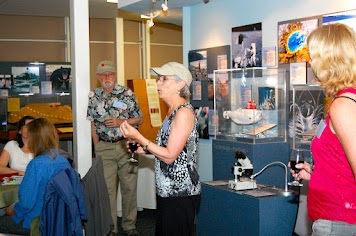
The COPUS Unconference wrapped up late on Sunday at the Biosphere2 with everyone exhausted but energized. The 60 or so invited participants spent a long weekend forming dozens of small to large groups to discuss and debate topics from hacker spaces to science cafes to media strategies to teacher training and beyond.
There are so many things going on around the country in getting people engaged in science that are so exciting which I've never heard of. The good news is that there are some amazingly brilliant, articulate, and passionate people who love doing this stuff. [Right, Judy Scotchmoor, co-founder of COPUS, offers explanation of the unconference format. At right, Sheri Potter from the American Institute of Biological Sciences, which hosts COPUS. Photo by Debra Winstead]
Langganan:
Postingan (Atom)